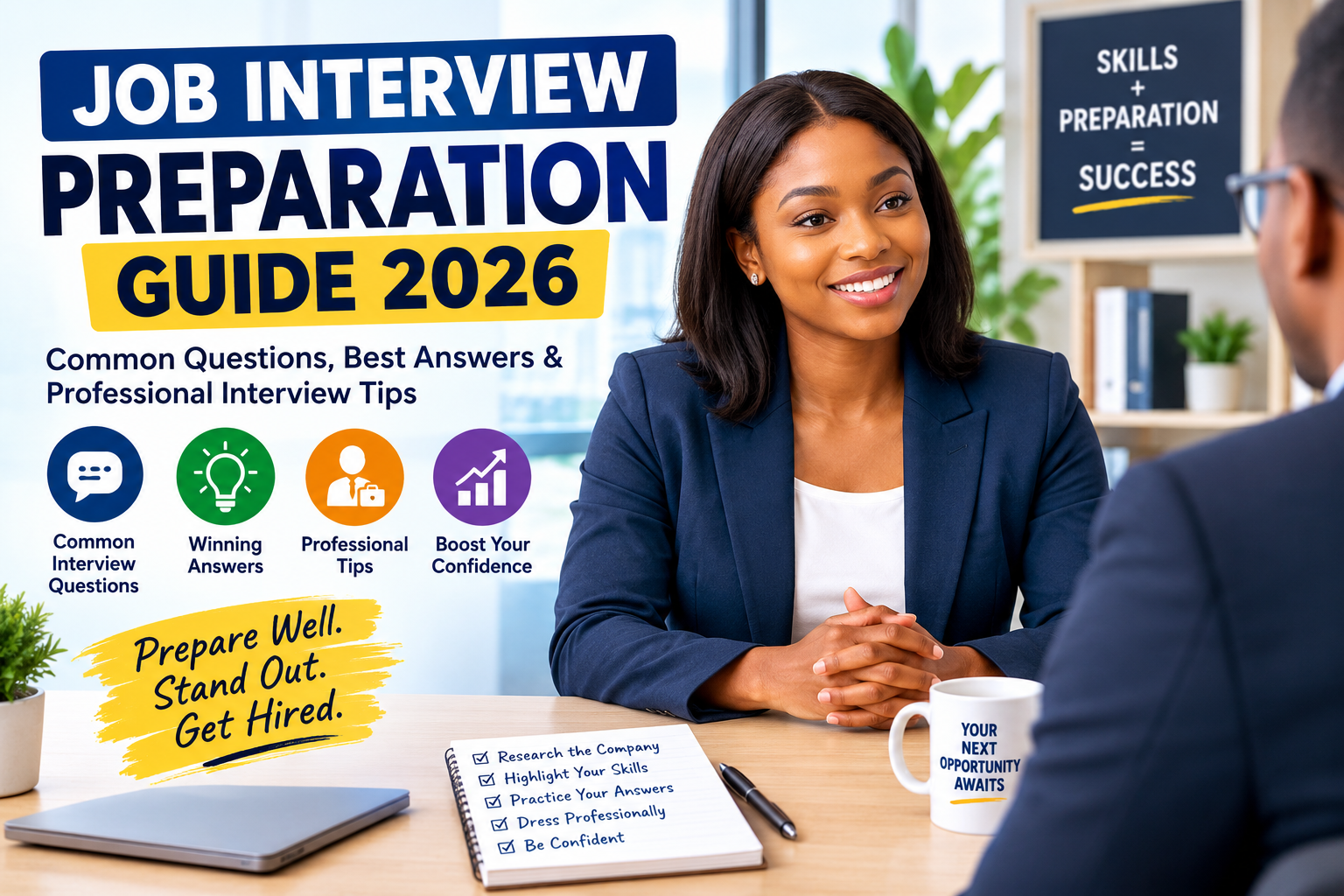
Prepare for your next job interview with this 2026 guide covering interview questions, professional answers, research, virtual interviews, salary discussions, and follow-up strategies.
Getting invited to a job interview is an important stage in the recruitment process, but the invitation itself does not guarantee a job offer.
The interview gives both sides an opportunity to evaluate the opportunity.
CareerOneStop, sponsored by the U.S. Department of Labor, advises candidates to research the employer and position, practice answers to common questions, prepare questions for the interviewer, and organize their interview-day logistics.
That preparation can be especially important for competitive professional roles, remote positions, international jobs, and careers requiring technical or professional qualifications.
What Is Job Interview Preparation?
Job interview preparation is the process of learning about the position, researching the employer, reviewing your own qualifications, practicing responses, preparing questions, and organizing the practical details of the interview.
Good preparation should cover four areas:
- The employer
- The position
- Your professional experience
- The interview format
Start With the Job Description
Read the job description carefully.
Identify:
- Required qualifications
- Preferred qualifications
- Technical skills
- Soft skills
- Years of experience
- Responsibilities
- Certifications
- Reporting structure
- Location
- Work arrangement
Then compare these requirements with your experience.
This helps you prepare examples that directly demonstrate relevant qualifications.
Research the Employer
Visit the organization’s official website.
Learn about:
- Products or services
- Customers
- Business model
- Leadership
- Recent developments
- Company values
- Job responsibilities
Avoid relying exclusively on social-media posts or third-party summaries.
For an international position, also investigate whether the employer is legally authorized to hire workers who require work authorization.
Prepare Your “Tell Me About Yourself” Answer
This is one of the most common opening questions.
Do not respond with your entire life story.
A useful structure is:
Present → Past → Future
Start with what you do professionally now.
Briefly explain relevant previous experience.
Then connect your background to the position.
Example:
“I’m a financial analyst with four years of experience working with budgeting, financial reporting, and business data. In my current role, I support monthly reporting and financial analysis for a growing organization. I’m now looking for a position where I can take on more responsibility in financial planning and business analysis.”
Keep the response relevant to the job.
Prepare for Behavioral Interview Questions
Behavioral questions often ask how you handled a specific situation.
Examples include:
- Tell me about a difficult project.
- Describe a time you made a mistake.
- Tell me about a conflict with a colleague.
- Describe a time you worked under pressure.
- Give an example of leadership.
- Tell me about a time you solved a problem.
The STAR structure can help:
Situation: What happened?
Task: What were you responsible for?
Action: What did you do?
Result: What happened afterward?
Use real examples.
CareerOneStop recommends preparing examples from your education and work experience and practicing answers aloud.
Prepare Questions for the Employer
An interview is not only an assessment of you.
It is also an opportunity to understand the role.
Useful questions include:
- What would success look like during the first six months?
- How is performance measured?
- What are the team’s main priorities?
- What professional development opportunities are available?
- What does a typical week look like?
- What are the next stages of the recruitment process?
CareerOneStop specifically recommends preparing questions about responsibilities, performance measurement, training, professional development, and organizational priorities.
How to Prepare for a Virtual Job Interview
Virtual interviews require additional technical preparation.
CareerOneStop recommends testing the computer, camera, microphone, meeting platform, internet connection, and interview environment before the interview.
Before the meeting:
- Test your camera.
- Test your microphone.
- Check your internet connection.
- Charge your device.
- Use a quiet location.
- Remove unnecessary background distractions.
- Close unrelated applications.
- Turn off unnecessary notifications.
- Keep your resume available.
- Join early.
Do not wait until the interview begins to discover that your microphone does not work.
What to Wear to a Job Interview
Your clothing should generally match the professional environment.
Research the employer’s workplace culture and choose professional attire appropriate to the position.
The objective is not to wear the most expensive clothing.
The objective is to look prepared and professional.
How to Discuss Your Salary Expectations
Salary questions can be difficult.
Before an interview, research the typical compensation range for comparable roles in the relevant market.
The U.S. Bureau of Labor Statistics provides occupational and wage information that can help job seekers research occupations and compensation.
CareerOneStop also includes salary negotiation among its job-search resources.
Do not claim a specific salary is guaranteed.
Compensation may vary according to:
- Location
- Industry
- Experience
- Employer
- Job responsibilities
- Qualifications
- Benefits
- Market conditions
How to Answer “Why Should We Hire You?”
Avoid generic statements.
Instead, connect three things:
Your experience + the employer’s need + the value you can provide
For example:
“My background combines customer-service experience with data analysis, which matches the reporting and client-support responsibilities described in this position. In my current role, I use customer data to identify recurring issues and improve service processes.”
The answer demonstrates relevance rather than simply making a claim.
What to Do After the Interview
After the interview, review:
- Questions you answered well
- Questions that were difficult
- Information you learned
- Follow-up items
- Any documents requested
A professional thank-you message can reinforce your interest and clarify any important point you did not explain adequately.
International Job Interviews
If you are interviewing for a job in another country, distinguish between being qualified for a job and being legally authorized to work there.
For example, Canada’s official immigration site explains that most foreign nationals need a work permit to work in Canada, although exemptions exist.
The UK’s official immigration portal lists work routes including the Skilled Worker visa.
For the United States, work authorization depends on the individual’s immigration category and circumstances. USCIS provides official information about employment authorization.
Do not pay someone simply because they claim they can “guarantee” a visa or job.
Always verify immigration information through the relevant government authority.
15 Common Interview Questions to Practice
- Tell me about yourself.
- Why are you interested in this position?
- What do you know about our organization?
- Why are you leaving your current job?
- What are your strongest skills?
- What professional area are you currently improving?
- Tell me about a challenging project.
- Describe a workplace conflict you resolved.
- Tell me about a mistake you made.
- How do you prioritize competing deadlines?
- Describe a successful project.
- Why should we hire you?
- What are your salary expectations?
- Where do you see your career developing?
- Do you have any questions for us?
Final Interview Preparation Checklist
Before the interview:
- Read the job description.
- Research the employer.
- Review your resume.
- Prepare professional examples.
- Practice common questions.
- Prepare questions.
- Confirm the interview time.
- Check the location or video link.
- Test your technology.
- Prepare appropriate clothing.
- Keep important documents accessible.
Conclusion
Strong interview preparation is not about memorizing perfect answers.
It is about understanding the position, knowing your professional story, preparing evidence of your skills, and communicating clearly.
Use your resume as the foundation for your answers. Then demonstrate how your experience connects to the employer’s actual needs.
For the next stage, read:
[Top Job Interview Questions and Answers for 2026: How to Prepare for Any Professional Interview]
Before applying for an international position, verify work authorization directly through the relevant government immigration authority.
Author Box
Craig Zen
Writer & Researcher at Night Watch NG
Craig Zen writes research-based career, employment, education, and international opportunity content for Night Watch NG, with a focus on practical guidance that helps readers make informed decisions. Articles are developed using authoritative sources and official government information where appropriate.

Leave a Reply