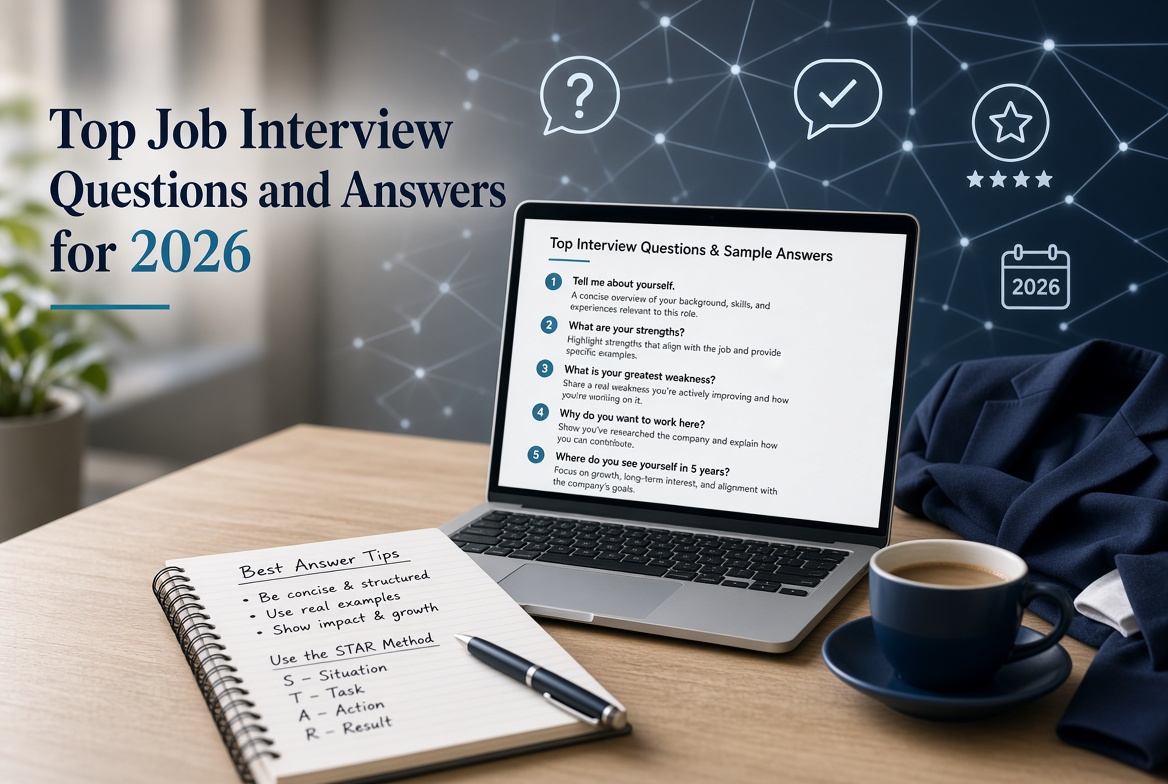
Prepare for your next job interview with this 2026 guide covering common interview questions, professional answers, interview preparation, resume consistency, salary discussions, and practical career tips.
A successful job interview is rarely about memorizing perfect answers. Employers want to understand how you communicate, how you approach problems, what you have accomplished, and whether your experience matches the requirements of the position.
That is why effective job interview preparation in 2026 should begin before you enter the interview room—or before you join a virtual interview.
The modern recruitment process can involve application screening, an Applicant Tracking System (ATS), recruiter conversations, technical assessments, behavioral interviews, panel interviews and, in some cases, multiple rounds with hiring managers. Your interview performance therefore needs to be consistent with the information presented on your resume and application.
The U.S. Bureau of Labor Statistics recommends using reliable occupational information when exploring careers, including information about education, training, experience, wages and job outlook.
For candidates who want to strengthen their professional profile, interview preparation can also work alongside targeted professional development and industry certifications. If you are considering a certification as part of your career strategy, see our detailed guide: Best Professional Certifications to Advance Your Career in 2026: Skills, Costs & Career Benefits
This guide explains how to prepare for common job interview questions, develop stronger answers, avoid common mistakes and present yourself professionally.
Why Job Interview Preparation Matters in 2026
Recruitment has become increasingly skills-focused. Employers may look beyond job titles and consider specific competencies, measurable accomplishments, technical knowledge, communication ability and evidence of continuous professional development.
Preparation helps you turn your experience into clear evidence.
Instead of simply saying:
“I am a hardworking person.”
you can explain what you accomplished, how you approached the problem and what happened as a result.
A strong interview answer generally connects three things:
- The situation or challenge
- The action you took
- The result or lesson
This is particularly useful for behavioral interview questions.
Preparation also reduces the likelihood of giving contradictory information. Your employment dates, job responsibilities, qualifications, certifications and career history should be reasonably consistent across your resume, application forms and interview responses.
1. Tell Me About Yourself
This is one of the most common job interview questions.
The interviewer usually does not need your entire life story. A better approach is to provide a concise professional summary that connects your background to the position.
A useful structure is:
Present → Past → Future
Example Answer
“I’m a marketing professional with experience in digital campaigns, content strategy and performance analysis. In my previous role, I worked on campaigns designed to increase qualified website traffic and improve customer engagement. Over time, I became particularly interested in using data to improve marketing decisions. I’m now looking for a position where I can combine my marketing experience with analytics and contribute to a larger growth-focused team.”
The answer is effective because it quickly establishes professional identity, relevant experience and career direction.
Avoid spending several minutes discussing personal information that has little connection to the job.
2. Why Do You Want to Work for Our Company?
This question tests whether you have researched the employer.
Before the interview, study:
- The company’s products or services
- Its industry
- The job description
- Recent company developments
- The skills emphasized in the vacancy
- The responsibilities of the position
- The organization’s stated values
Then connect those details to your experience.
Example Answer
“I’m interested in this position because it combines project coordination, client communication and data-driven decision-making, which are areas where I have developed strong experience. I also noticed that the role involves working across several teams, and that appeals to me because some of my strongest results have come from coordinating people with different responsibilities.”
The important point is specificity.
Avoid saying only:
“I want to work here because your company is successful.”
Thousands of candidates can say that.
3. What Are Your Greatest Strengths?
Choose strengths that are relevant to the position.
Potential examples include:
- Analytical thinking
- Project management
- Communication
- Technical skills
- Customer service
- Leadership
- Organization
- Problem-solving
- Adaptability
- Attention to detail
However, simply naming strengths is not enough.
Use evidence.
Weak Answer
“I’m very organized.”
Stronger Answer
“Organization is one of my strongest skills. In my previous role, I managed several projects simultaneously by creating weekly priorities, tracking deadlines and maintaining a shared project schedule. That helped the team reduce missed deadlines and made it easier to identify problems before they became urgent.”
The second answer demonstrates the skill instead of merely claiming it.
4. What Is Your Greatest Weakness?
This question can make candidates uncomfortable.
Do not choose a weakness that would make you fundamentally unsuitable for the job.
Instead, identify a genuine professional development area and explain how you are addressing it.
Example
“Earlier in my career, I sometimes spent too much time refining work before sharing an initial version with colleagues. I have improved by setting earlier review points and asking for feedback sooner. That has helped me work more efficiently while maintaining quality.”
The answer demonstrates self-awareness and improvement.
Avoid cliché responses such as:
“My weakness is that I work too hard.”
Hiring managers hear variations of this answer frequently.
5. Why Should We Hire You?
This is an opportunity to summarize your value.
A strong answer should connect:
Your skills + your experience + the employer’s needs.
Example
“I believe I can contribute because my background combines customer-facing experience with data analysis. The job description emphasizes client communication, reporting and problem-solving, and those are areas where I have practical experience. I also enjoy learning new systems quickly, so I would be comfortable adapting to your internal processes.”
Do not claim that you are guaranteed to be the best candidate.
Focus on evidence.
6. Why Did You Leave Your Previous Job?
Keep your response factual and professional.
Even if your previous workplace was difficult, avoid attacking former managers or colleagues.
Possible professional explanations include:
- Seeking career advancement
- Looking for a position aligned with new skills
- Relocation
- Organizational restructuring
- Contract completion
- Career transition
- Pursuing additional professional development
Example
“I learned a great deal in my previous position, but I reached a point where I wanted to take on more responsibility in project management. This role attracted me because it provides an opportunity to build on the experience I already have while taking on more complex projects.”
7. Where Do You See Yourself in Five Years?
Employers may use this question to understand your career direction and whether the role fits your professional goals.
Your answer does not need to predict your exact job title.
Instead, discuss skills and responsibilities you hope to develop.
Example
“Over the next five years, I want to become highly skilled in strategic project management, take responsibility for larger projects and eventually mentor junior colleagues. I also plan to continue developing my technical and leadership skills.”
This demonstrates ambition without making unrealistic promises.
8. Describe a Difficult Problem You Solved
Behavioral questions are often easier to answer using the STAR method:
S — Situation
Explain the context.
T — Task
Describe your responsibility.
A — Action
Explain what you personally did.
R — Result
Describe the outcome.
Example
“At my previous company, a major project was falling behind schedule because several departments were working from different timelines. I was responsible for coordinating the project schedule. I created a central timeline, identified dependencies and introduced short weekly status meetings. Within several weeks, the teams had a shared understanding of deadlines and the project returned to its planned schedule.”
Whenever possible, use measurable results.
9. How Do You Handle Pressure?
Do not simply say:
“I work well under pressure.”
Explain your process.
For example:
“When several deadlines overlap, I first identify which tasks have the greatest business impact and which deadlines are fixed. I then break the work into smaller tasks and communicate early if I identify a potential conflict. This approach helps me remain focused rather than reacting to everything simultaneously.”
10. Tell Me About a Time You Failed
The purpose is not necessarily to find someone who has never failed.
Professional work involves mistakes, setbacks and projects that do not go according to plan.
Choose an example where you learned something useful.
A good answer should contain:
- What happened
- Your responsibility
- What you learned
- What you changed afterward
Avoid blaming another person.
11. What Is Your Expected Salary?
Salary questions should be handled carefully.
Research the position, location, experience requirements and market conditions before the interview.
The U.S. Bureau of Labor Statistics provides occupational wage information that can help job seekers research compensation by occupation and location.
A professional response might be:
“Based on the responsibilities of the role, my experience and the market range I have researched, I would expect compensation within a competitive range for this position. I’m also interested in understanding the complete compensation package and responsibilities before settling on a specific figure.”
If the employer requests a specific number, provide a researched range when appropriate.
Do not invent competing offers or misrepresent your current compensation.
Resume Preparation Before the Interview
Your interview preparation should begin with your resume.
Recruiters may ask questions based directly on information appearing on your CV, including:
- Previous employers
- Employment dates
- Job responsibilities
- Qualifications
- Certifications
- Career achievements
- Employment gaps
- Technical skills
- Leadership experience
Before submitting your application, review your resume carefully.
For a detailed guide, read How to Write an ATS-Friendly Resume in 2026: Professional CV Format, Keywords & Job Application Tips.
You can also read How to Optimize Your Resume for Applicant Tracking Systems (ATS): 2026 Step-by-Step Guide for additional guidance on formatting and keyword alignment.
The goal is not to manipulate an ATS. The goal is to make your qualifications clear, accurate and relevant to the position.
Keep Your Resume and Interview Answers Consistent
Consistency matters.
Suppose your resume says you managed a team of eight employees, but during the interview you state that you only coordinated two people. That discrepancy could create unnecessary questions.
Your:
- Resume
- LinkedIn profile
- Cover letter
- Application
- Interview answers
should tell a broadly consistent professional story.
Consistency does not mean memorizing your resume word-for-word.
Instead, know your own professional history well enough to explain it naturally.
Professional Certifications Can Strengthen Your Interview
Professional certifications can demonstrate knowledge or occupation-specific skills, although their value varies by industry, employer and position.
The U.S. Bureau of Labor Statistics distinguishes certifications from licenses: certifications are generally issued by non-governmental certification bodies, while occupational licenses are issued by government agencies and provide legal authority to work in regulated occupations.
BLS data also show that credential requirements differ substantially between occupations.
If a certification appears on your resume, expect interviewers to ask:
- Why did you pursue it?
- What did you learn?
- How have you applied the knowledge?
- Is it current?
- How does it relate to this position?
For candidates researching career credentials, read Best Professional Certifications to Advance Your Career in 2026: Skills, Costs & Career Benefits.
How to Prepare for a Technical Interview
Technical interviews can involve:
- Practical exercises
- Coding assessments
- Case studies
- Data analysis
- Technical questions
- Portfolio reviews
- Troubleshooting scenarios
- Industry-specific assessments
Do not prepare only by memorizing definitions.
Practice explaining your reasoning.
An interviewer may care as much about your approach to a problem as the final answer.
For example, a software developer may be asked to explain how they would diagnose a production problem. A financial analyst may be asked to interpret a dataset. A project manager may receive a scenario involving competing deadlines.
Practice thinking aloud clearly and logically.
How to Prepare for a Virtual Job Interview
Remote interviews require additional preparation.
Before the interview:
- Test your camera.
- Test your microphone.
- Check your internet connection.
- Charge your device.
- Choose a quiet location.
- Position your camera at a comfortable height.
- Remove distracting background elements.
- Keep your resume nearby.
- Have the job description available.
- Join the meeting early.
Do not read answers directly from a script.
Use brief notes as reminders, but maintain natural conversation.
Questions You Should Ask the Interviewer
An interview is also an opportunity to understand the position.
Consider asking:
- What would success look like during the first six months?
- What are the most important responsibilities in this position?
- How is performance evaluated?
- What professional development opportunities are available?
- What challenges is the team currently addressing?
- How does the position work with other departments?
- What are the next steps in the hiring process?
Avoid asking only about salary, vacation or benefits during the first few minutes.
Those subjects may be important, but the timing matters.
Common Job Interview Mistakes to Avoid
1. Arriving unprepared
Research the company and position.
2. Giving extremely long answers
Answer the question directly and provide evidence.
3. Memorizing scripted responses
Preparation should improve confidence, not make you sound robotic.
4. Criticizing former employers
Remain professional.
5. Exaggerating achievements
Interviewers may ask follow-up questions.
6. Failing to research salary expectations
Use credible labor-market information.
7. Ignoring your resume
Review everything you submitted.
8. Asking no questions
Prepare several thoughtful questions.
9. Forgetting follow-up communication
A concise professional follow-up message can reinforce your interest.
Interview Preparation Checklist for 2026
Before the interview, confirm that you have:
- Reviewed the job description
- Researched the employer
- Prepared a professional introduction
- Reviewed your resume
- Prepared examples using STAR
- Practiced common interview questions
- Researched salary information
- Prepared questions for the interviewer
- Tested your technology if the interview is virtual
- Prepared appropriate professional clothing
- Verified the interview time and location
- Prepared relevant certificates or portfolio materials
International Applicants: Verify Work Authorization Separately
International candidates should distinguish between being qualified for a job and being legally authorized to work in a particular country.
For U.S. opportunities, employment authorization depends on immigration status and the applicable rules. USCIS provides official information about Employment Authorization Documents and Form I-765 for eligible individuals.
Use the official U.S. Citizenship and Immigration Services employment authorization information rather than relying on social-media posts or unofficial immigration claims.
For immigration matters, always verify current requirements directly with the relevant government authority because immigration rules, forms, fees and eligibility requirements can change.
Final Thoughts
A strong interview is not simply a performance.
It is an opportunity to demonstrate that your experience, skills, qualifications and career goals align with the position.
The best preparation is therefore practical. Study the role, understand your own experience, prepare examples, research the employer and make sure the information across your resume and interview answers is accurate and consistent.
Professional certifications may also support career development when they are relevant to your target occupation. However, a credential should complement practical experience rather than replace it.
Most importantly, prepare enough to become confident without sounding rehearsed.
Author Box
About the Author
Craig Zen is a Writer & Researcher at Night Watch NG, covering career development, employment opportunities, professional skills, international job applications and practical workplace guidance. His work focuses on presenting useful career information in a clear, accessible and research-based format for job seekers and professionals.
Editorial Note: Career requirements, employment regulations, salaries and professional credentials can change. Readers should verify important employment and immigration information with the relevant employer or official government authority before making decisions.

Leave a Reply