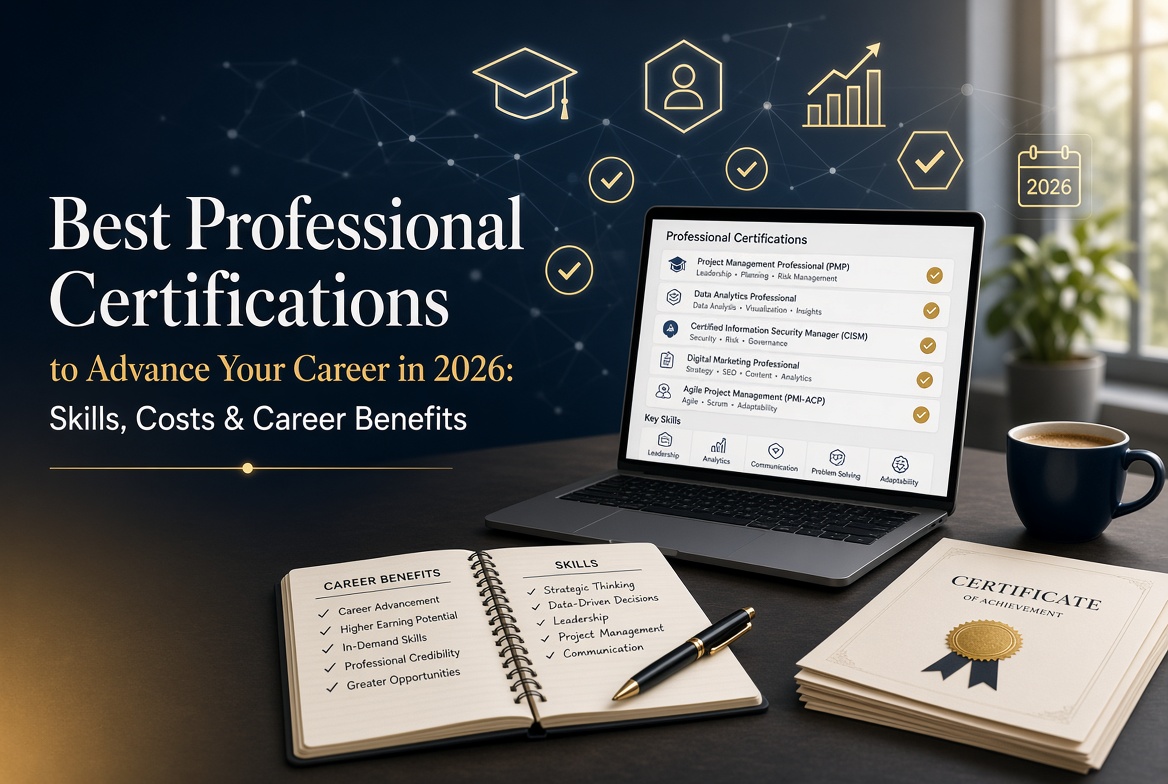
Explore professional certifications that can support career development in 2026, including project management, cybersecurity, cloud computing, data analytics, finance and business credentials.
Professional certifications have become an important part of career development for workers seeking to strengthen specialized skills, demonstrate technical knowledge or qualify for particular professional opportunities.
However, choosing a certification should involve more than searching for a credential with a high salary claim attached to it.
The right certification depends on your occupation, experience, employer requirements, industry, location, budget and long-term career goals.
The U.S. Bureau of Labor Statistics defines professional certifications as credentials that demonstrate a level of skill or knowledge, while licenses are generally government-issued credentials that provide legal authority to work in regulated occupations.
That distinction is important.
A certification may strengthen a candidate’s professional profile, but it does not automatically create a job, guarantee a salary or substitute for required work experience.
If you are currently preparing for interviews, combine your certification research with practical interview preparation. Our guide Top Job Interview Questions and Answers for 2026: How to Prepare for Any Professional Interview explains how to discuss your qualifications, experience and career development during an interview.
This guide examines major certification categories, potential costs, skills developed, career applications and the factors you should consider before paying for a professional credential.
Why Professional Certifications Matter in 2026
Employers increasingly evaluate candidates according to combinations of:
- Education
- Work experience
- Technical skills
- Professional credentials
- Communication
- Problem-solving
- Industry knowledge
- Demonstrated results
Certification is one component of that picture.
BLS data distinguish certification and licensing status across the U.S. workforce and provide statistics on employment, earnings and occupational categories.
BLS also reports that credential requirements vary considerably by occupation. In its 2025 Occupational Requirements Survey data, 22.9% of civilian workers were in occupations requiring a license or certification, while other credential categories covered additional workers.
That does not mean every worker needs a certification.
It means credentials are significant in some parts of the labor market and much less important in others.
The smart approach is to start with the job you want and work backward.
How to Choose the Right Professional Certification
Before paying for an examination or training program, ask five questions.
1. Is the credential relevant to my target job?
A certification has greater practical value when employers in your field recognize and use it.
2. Is it required, preferred or optional?
These are very different situations.
3. What skills does it actually demonstrate?
Read the examination objectives and certification requirements.
4. What is the complete cost?
Consider:
- Training
- Examination
- Study materials
- Retake fees
- Renewal
- Continuing education
- Membership fees
5. Will I be able to demonstrate the skills?
A certificate on a resume is useful, but practical application makes the credential easier to discuss during an interview.
CareerOneStop, sponsored by the U.S. Department of Labor, provides a certification finder that allows users to research credentials by occupation, industry and certification organization.
1. Project Management Certifications
Project management remains a valuable professional skill across technology, construction, healthcare, finance, consulting, government and many other industries.
Project management credentials can be useful for professionals involved in:
- Project planning
- Risk management
- Scheduling
- Budget management
- Stakeholder communication
- Team coordination
- Process improvement
Well-known credentials include certifications from established professional bodies and training providers.
One widely recognized example is the Project Management Professional (PMP) credential administered by the Project Management Institute.
However, eligibility requirements, examination fees and renewal rules can change, so candidates should verify current details directly with the certification organization before enrolling.
Skills developed
Project management study commonly covers:
- Project planning
- Risk
- Scope
- Scheduling
- Stakeholder management
- Quality
- Communication
- Resource management
Potential career applications
A project management credential may be relevant to roles such as:
- Project coordinator
- Project manager
- Program manager
- Operations manager
- Implementation specialist
- Business analyst
The certification itself should not be presented as a guarantee of employment.
2. Cybersecurity Certifications
Cybersecurity is another major certification category for professionals entering or advancing within information technology.
The field includes:
- Network security
- Security operations
- Identity management
- Risk management
- Cloud security
- Incident response
- Governance
- Compliance
Possible certification pathways include entry-level cybersecurity credentials as well as advanced security certifications.
Examples include credentials associated with organizations such as CompTIA, ISC2, ISACA and other recognized certification bodies.
The appropriate choice depends heavily on experience.
An entry-level candidate may need a different credential from a professional already working in security engineering or security management.
Why cybersecurity certifications can be useful
Cybersecurity employers often need candidates who understand technical concepts as well as organizational risk.
Certification preparation can help structure learning around:
- Security principles
- Network concepts
- Risk
- Threats
- Access controls
- Incident response
- Governance
However, practical laboratory experience and technical projects can be equally important when applying for technical positions.
3. Cloud Computing Certifications
Cloud technology has become an important skill area across modern IT environments.
Major cloud platforms offer certification pathways covering areas such as:
- Cloud fundamentals
- Architecture
- Administration
- Security
- Data
- DevOps
- Machine learning
- Solutions architecture
Credentials are available from major providers including Amazon Web Services, Microsoft Azure and Google Cloud.
Because certification programs and examination prices can change, candidates should check the current official certification pages before budgeting.
Career applications
Cloud credentials may be relevant to:
- Cloud support roles
- Cloud administrators
- Cloud engineers
- Solutions architects
- DevOps professionals
- Cloud security specialists
- Data professionals
A certification is particularly useful when paired with practical cloud projects.
4. Data Analytics Certifications
Data has become central to decision-making in many organizations.
Data analytics professionals may work with:
- Spreadsheets
- SQL
- Business intelligence tools
- Statistical analysis
- Data visualization
- Databases
- Reporting
- Dashboard development
Certification options vary widely.
Some focus on particular software platforms, while others emphasize broader analytics concepts.
Skills worth developing
Regardless of the credential, candidates should consider building practical ability in:
- Excel or equivalent spreadsheet tools
- SQL
- Data visualization
- Statistics
- Dashboard creation
- Data cleaning
- Business communication
A certificate becomes more persuasive when you can show a portfolio demonstrating what you can actually do.
5. Accounting and Finance Certifications
Finance and accounting contain numerous professional credentials, including specialized qualifications for accounting, auditing, financial analysis and risk.
Examples of recognized professional pathways include:
- CPA
- CFA
- CMA
- CIA
- Risk-related credentials
- Financial planning credentials
Requirements vary considerably.
Some professional credentials require education, examinations, supervised experience or continuing professional education.
Do not assume that completing an online course is equivalent to obtaining a regulated professional license or recognized professional qualification.
For regulated financial professions, verify requirements with the relevant professional body and government authority in the jurisdiction where you intend to work.
6. Human Resources Certifications
Human resources professionals can pursue credentials related to:
- Recruitment
- Employee relations
- Compensation
- Benefits
- HR strategy
- Workforce planning
- Employment law
- Talent management
Credentials from recognized HR organizations may be relevant to HR specialists, HR managers and professionals transitioning into people-management careers.
BLS occupational profiles can help candidates understand typical education, experience and certification expectations for specific occupations.
7. IT Support and Networking Certifications
Professionals beginning an IT career may consider credentials covering:
- Hardware
- Networking
- Operating systems
- Troubleshooting
- Cloud fundamentals
- Security
- Technical support
Entry-level certifications can provide structured learning for people without extensive professional experience.
However, hands-on practice remains important.
Build a home lab where appropriate, work on practical projects and document your technical experience.
A hiring manager is likely to be more interested in what you can actually troubleshoot than in a list of certificates alone.
8. Business Analysis Certifications
Business analysts connect business needs with processes, technology and data.
Relevant skills can include:
- Requirements gathering
- Process mapping
- Stakeholder interviews
- Data analysis
- Documentation
- Problem-solving
- Business process improvement
Professional credentials can help provide a structured framework for learning.
But candidates should also develop the ability to explain how they have analyzed problems and recommended solutions.
9. Supply Chain and Logistics Certifications
Supply chain professionals work across:
- Procurement
- Inventory
- Transportation
- Warehousing
- Demand planning
- Operations
- Supplier management
Credentials from established supply-chain organizations can help professionals develop specialized knowledge.
Potential benefits may include a stronger understanding of industry terminology and processes.
However, candidates should evaluate the credential against their specific career objective before paying for it.
10. Healthcare Certifications and Licenses
Healthcare is a particularly important area where the distinction between certification and licensing matters.
Some healthcare occupations require government-issued licenses.
Others may involve certifications from professional organizations.
The exact requirements depend on the occupation and jurisdiction.
Because healthcare credentials can affect legal eligibility to practice, candidates should verify requirements through the relevant state, national or professional regulatory authority.
A general online certificate should never be presented as a substitute for a legally required healthcare license.
Certification Costs: What Should You Budget For?
One of the biggest mistakes professionals make is looking only at the examination fee.
The true cost can include:
| Cost Category | What to Consider |
|---|---|
| Training | Courses, instructor-led classes or self-study |
| Examination | Initial examination fee |
| Study materials | Books, practice exams and labs |
| Retakes | Additional examination attempts |
| Membership | Professional association fees |
| Renewal | Periodic credential renewal |
| Continuing education | Courses or professional development |
| Travel | Possible testing-center expenses |
Prices differ significantly by certification.
Always check the certification provider’s official website before budgeting.
Do not rely on an old blog post for current examination fees.
How Professional Certifications Can Support Career Advancement
A certification can potentially support career development in several ways.
Demonstrating Specialized Knowledge
A relevant credential can give employers additional evidence that you have studied a specific technical or professional subject.
Structuring Your Learning
Certification programs provide defined objectives.
That can make self-directed learning easier.
Supporting Career Transitions
Someone moving from general administration into project management, for example, may use a relevant credential as one component of a broader transition strategy.
Improving Professional Vocabulary
Certifications can expose candidates to industry frameworks, terminology and practices.
Strengthening Interview Discussions
A certification gives you another subject to discuss during interviews.
However, be prepared to explain what you actually learned.
Certification vs. Degree: Which One Should You Choose?
This is not always an either-or decision.
A degree and professional certification serve different purposes.
A degree may provide broader academic education, while a professional certification can focus on a specific skill set or occupational competency.
The right option depends on:
- Your current education
- Your occupation
- Employer requirements
- Career stage
- Budget
- Time available
- Long-term goals
BLS career information can help job seekers compare occupations by education, training, pay and projected employment.
How to Put Certifications on Your Resume
Do not hide relevant credentials at the bottom of a long resume.
For important certifications, consider a dedicated section.
Example
Professional Certifications
- Project Management Professional (PMP) — Project Management Institute
- Certified Information Systems Security Professional (CISSP) — ISC2
- AWS Certified Solutions Architect — Associate
- Microsoft Certified: Azure Administrator Associate
Only list credentials you actually hold.
Do not use “certified” if you merely completed a course.
If a certification expires, maintain accurate status information.
How to Discuss Certifications During an Interview
Interviewers may ask:
“Why did you pursue this certification?”
A strong answer connects the credential to your career objective.
For example:
“I pursued the certification because I wanted to strengthen my understanding of project planning and risk management. I also wanted a structured framework that I could apply to the projects I manage professionally.”
They may also ask:
“How have you used what you learned?”
This is where practical examples become valuable.
Do not simply repeat the examination syllabus.
Explain how the knowledge affected your work.
For additional interview preparation, read Top Job Interview Questions and Answers for 2026: How to Prepare for Any Professional Interview.
Keep Your Certification, Resume and Interview Story Consistent
Your professional profile should tell one coherent story.
For example:
Resume:
“Certified project management professional with experience coordinating technology projects.”
Interview:
You should be able to explain the projects you coordinated and how the certification relates to that work.
LinkedIn:
Your certification details should accurately reflect your actual credential.
This is especially important for candidates applying through competitive recruitment processes.
You should also ensure that your resume accurately presents your technical skills and keywords. Our detailed guide, How to Optimize Your Resume for Applicant Tracking Systems (ATS): 2026 Step-by-Step Guide, explains how to make your qualifications easier for recruitment systems and human reviewers to understand.
How to Evaluate the Return on Investment of a Certification
Instead of asking:
“Is this certification expensive?”
ask:
“What problem is this certification solving for my career?”
Consider the following:
Career relevance
Does it directly relate to your desired position?
Employer recognition
Do employers in your target industry recognize the credential?
Entry requirements
Can you realistically qualify?
Total cost
What will the entire credential cost?
Renewal requirements
Will you need to renew it?
Practical application
Can you use the skills immediately?
Job-market relevance
Are the skills connected to occupations you are targeting?
BLS provides occupation-level information on education, training, wages and projected employment, which can be useful when researching the market before investing in professional development.
Avoid Certification Scams and Misleading Training Claims
The growing demand for professional development has also created opportunities for misleading certification providers.
Be cautious of websites claiming:
- Guaranteed employment
- Guaranteed six-figure salaries
- Guaranteed visa sponsorship
- Guaranteed promotions
- Instant professional licensing
- Guaranteed immigration
- Guaranteed interviews
A legitimate training provider should clearly explain:
- Who issues the credential
- Examination requirements
- Eligibility requirements
- Costs
- Renewal rules
- What the credential represents
Do not confuse a course-completion certificate with a professional certification or government-issued license.
Professional Certifications for International Job Seekers
International applicants should research credentials in the country where they intend to work.
A certification may demonstrate skills, but it does not automatically provide immigration status or employment authorization.
For people considering employment in the United States, immigration and work authorization are separate issues from professional certification.
USCIS explains that employment authorization depends on the individual’s immigration circumstances and applicable eligibility category. Certain eligible individuals may use Form I-765 to request an Employment Authorization Document.
Therefore:
Certification ≠ visa
and
Certification ≠ automatic work authorization.
For immigration decisions, use official government sources rather than relying solely on recruitment websites or social-media posts.
Best Strategy for Combining Certifications With Career Development
A certification works best as part of a larger career-development plan.
A practical strategy can look like this:
Step 1: Choose a target occupation
Identify the job you actually want.
Step 2: Research employer requirements
Review real job advertisements.
Step 3: Identify skill gaps
Compare your existing skills with the requirements.
Step 4: Select relevant training
Choose education or certification that addresses those gaps.
Step 5: Build practical experience
Create projects, volunteer, freelance or gain workplace experience where appropriate.
Step 6: Update your resume
Present the new credential accurately.
Step 7: Prepare for interviews
Practice explaining what you learned.
Step 8: Continue developing
Career development does not stop when you receive a certificate.
Certification Planning Checklist for 2026
Before enrolling, ask:
- Is this credential relevant to my target occupation?
- Who issues it?
- Is the issuer recognized by employers?
- What are the eligibility requirements?
- What is the examination cost?
- Is training mandatory?
- How much will study materials cost?
- Are there renewal requirements?
- Does the credential expire?
- Is continuing education required?
- Do employers actually mention it in job postings?
- Can I demonstrate the underlying skills?
- Is there a cheaper or more relevant alternative?
- Does my target occupation require a license instead?
These questions can prevent unnecessary spending.
Final Thoughts
Professional certifications can be valuable career-development tools, but their usefulness depends on context.
The most effective credential is not necessarily the one with the most impressive marketing or the highest salary claim attached to it. It is the credential that addresses a genuine skill requirement, is recognized in your target field and fits your professional goals.
Research the occupation first.
Then research employers.
Then compare certification providers, requirements and total costs.
The U.S. Bureau of Labor Statistics provides extensive occupational information, including education, training, wages and employment projections, while CareerOneStop provides tools for researching certifications.
Finally, remember that a certification is evidence of learning or competency—not a promise of employment.
Combine the credential with practical experience, a well-structured resume, strong interview skills and continuous professional development.
For candidates preparing for interviews after earning a new credential, read our guide: Top Job Interview Questions and Answers for 2026: How to Prepare for Any Professional Interview.
Author Box
About the Author
Craig Zen is a Writer & Researcher at Night Watch NG, covering career development, professional certifications, employment opportunities, international careers and practical job-search strategies. His work focuses on producing accessible, research-based career information for professionals, graduates and job seekers.
Editorial Note: Certification names, examination fees, eligibility requirements, renewal rules, employment regulations and immigration policies can change. Readers should verify current information directly with the relevant certification organization, employer or government authority before making financial or career decisions.

Leave a Reply