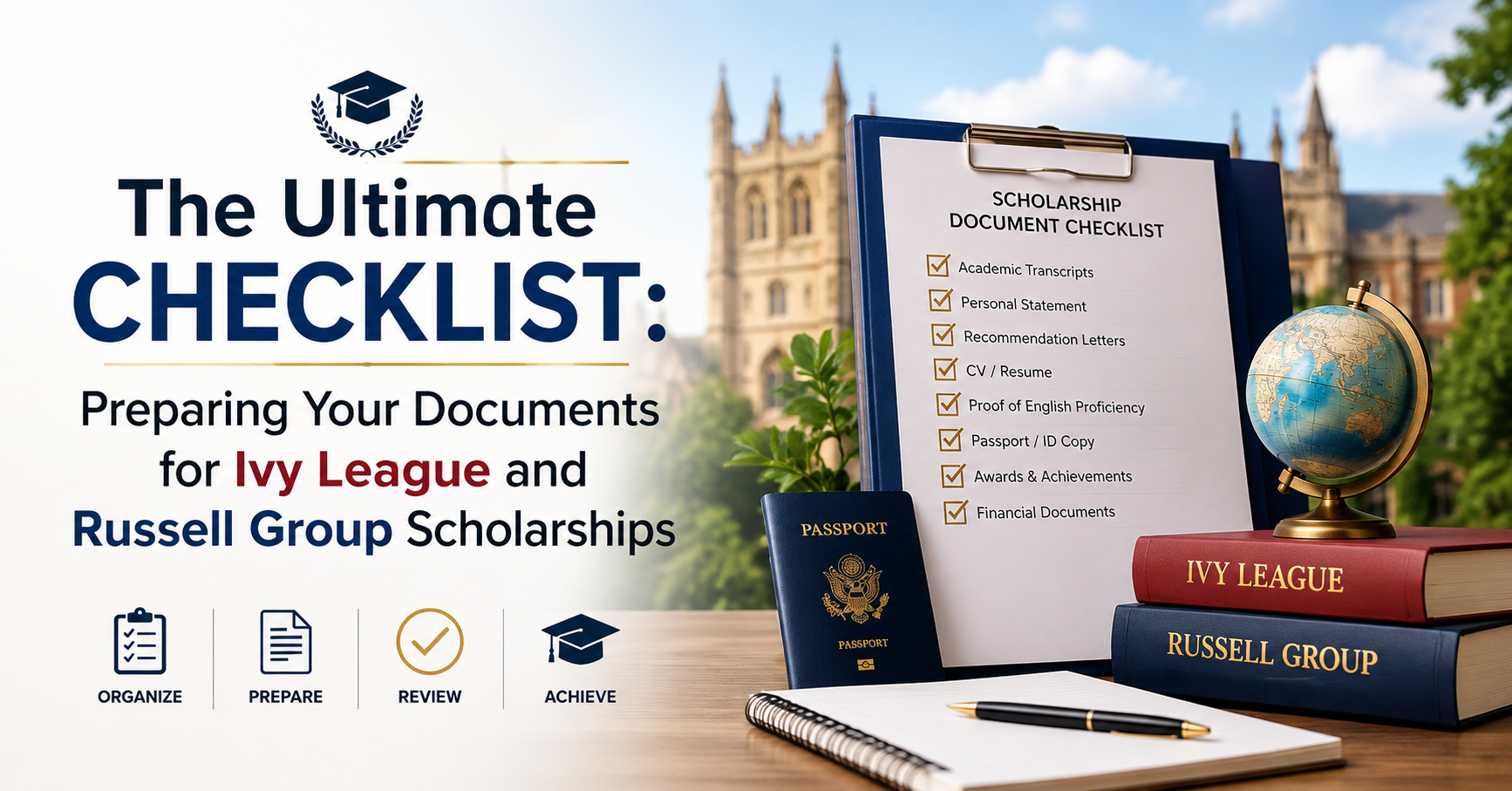
Applying for a scholarship at an Ivy League university or a Russell Group institution in the UK is not something you can pull together over a weekend. The paperwork alone can feel like a part-time job, and one missing signature or outdated transcript can push your application to the bottom of a reviewer’s pile. If you’ve ever stared at an admissions portal wondering whether you’ve actually gathered everything you need, you’re not alone — this is one of the most common sources of stress for ambitious students every application cycle.
This guide walks through exactly what these elite institutions expect from you on paper, why each document matters, and how to avoid the small mistakes that quietly sink otherwise strong applications. Whether you’re aiming for a need-based grant at Harvard, a merit scholarship at Yale, or a fully-funded place at Oxford or the London School of Economics, the underlying preparation looks remarkably similar. Get the fundamentals right, and you free yourself up to focus on what actually differentiates you: your story.
Why Document Preparation Matters More Than You Think
Admissions committees at Ivy League and Russell Group schools read thousands of applications each year. Scholarship panels, which are often smaller and more specialised, read fewer files but scrutinise each one more closely. They are looking for consistency between what you claim and what you can prove. A personal statement that talks about leadership, unsupported by any evidence in your activity records or references, raises questions. A transcript that doesn’t match the grades mentioned in your essay raises even more.
In other words, your documents are not a formality tacked onto the “real” application. They are part of the argument you’re making about who you are and why you deserve funding. Treating them as an afterthought is one of the costliest mistakes applicants make.
1. Academic Transcripts and Records
Every scholarship committee wants official proof of your academic history, and the standards here are stricter than most students expect.
What you’ll typically need:
- Official transcripts from every secondary school or university you’ve attended, not just your current one
- Transcripts translated into English by a certified translator if your original documents are in another language
- Grade conversion or equivalency statements, particularly important for Russell Group applications where UCAS or direct university systems require UK-equivalent grading
- Sealed or digitally verified copies sent directly from your institution, since many committees will not accept documents forwarded by the applicant
A frequent misstep is submitting an unofficial transcript printed from a student portal. Most scholarship boards, including many Ivy League financial aid offices, require documents bearing an institutional seal, registrar’s signature, or secure digital verification. Start this process early, because school registrars can take weeks to process requests, especially during peak application season.
2. Standardised Test Scores
Not every scholarship requires standardised testing anymore, but for those that do, timing is everything.
- SAT or ACT scores for most US-based scholarships, sent directly through the College Board or ACT reporting systems
- English proficiency scores such as IELTS or TOEFL for international applicants, required by nearly all Russell Group universities and most Ivy League schools for non-native English speakers
- Subject-specific tests, such as SAT Subject Tests or Advanced Placement scores, occasionally requested by more competitive merit scholarships
Score reports have expiry windows, and rescheduling a test because your previous score has lapsed can derail an entire application timeline. Check the validity period for each test against your intended submission date well before you begin the rest of your paperwork.
3. Letters of Recommendation
Recommendation letters carry enormous weight, particularly for scholarships that assess character and potential rather than grades alone.
Best practices for this section:
- Approach recommenders at least six to eight weeks before the deadline
- Choose people who can speak to specific qualities — a teacher who watched you lead a group project, not just someone with a senior title
- Provide your recommenders with a short brief covering the scholarship’s values, your key achievements, and any specific angle you’d like them to address
- Confirm the submission method, since some scholarships require letters uploaded directly by the recommender through a secure portal rather than emailed by the applicant
A generic, one-size-fits-all letter is easy for reviewers to spot, and it rarely helps your case. The strongest letters are specific, anecdotal, and clearly written by someone who knows the applicant well.
4. Personal Statement and Supplementary Essays
While not a “document” in the traditional sense, your personal statement functions as the connective tissue between all your other paperwork. Reviewers will cross-reference it against your transcripts, activities list, and recommendation letters, so consistency matters.
Common requirements include:
- A primary personal statement, often 500–650 words for US applications or up to 4,000 characters for UCAS-based UK applications
- Supplementary essays specific to individual scholarships, sometimes asking why you’ve chosen that particular fund or how you plan to use the opportunity
- A statement of purpose for graduate-level scholarships, outlining research interests or career goals in more technical detail
Draft these early, then leave them for a few days before revising. Distance from your own writing makes it far easier to catch overused phrases, vague claims, or sections that don’t quite match the evidence in your other documents.
5. Financial Documentation
This is where many scholarship applications, particularly need-based ones, tend to stall. Financial paperwork requirements vary significantly between US and UK systems.
For Ivy League need-based aid, expect to provide:
- CSS Profile or FAFSA submissions, depending on citizenship status
- Parental tax returns or income statements, sometimes requiring notarised translations for international families
- Bank statements or asset declarations for non-US applicants
For Russell Group scholarships, requirements often include:
- Household income evidence, particularly for bursaries tied to financial need
- Proof of residency status, which affects both tuition classification and scholarship eligibility
- Sponsor letters if a third party, rather than the family, is funding part of the education
Financial documents are frequently the most time-consuming to gather because they depend on other people — parents, employers, banks — responding promptly. Build in extra buffer time here specifically.
6. Identification and Citizenship Documents
Every scholarship program needs to verify who you are and, in many cases, your eligibility based on nationality or residency.
- A valid passport or national identification document
- Visa documentation for applicants studying outside their home country
- Proof of residency where scholarships are restricted to specific regions or countries
- Birth certificates, occasionally requested for certain named or legacy scholarship funds with specific eligibility criteria
Double-check expiry dates on all identification documents before submission. A passport expiring during your intended study period can create complications even after a scholarship has been awarded.
7. Portfolio or Supplementary Materials
For scholarships tied to specific talents — art, music, writing, research — a portfolio is often mandatory rather than optional.
- Curated samples of your best work, quality prioritised over quantity
- A brief artist’s or researcher’s statement contextualising each piece
- Formatting according to the exact specifications requested, since portfolios submitted in the wrong file type or resolution are sometimes rejected outright by automated systems before a human ever reviews them
8. Application Forms and Checklists Specific to Each Scholarship
It sounds obvious, but missing a scholarship-specific form is one of the most common reasons applications get flagged as incomplete.
- Read the full list of requirements for each individual scholarship, not just the general university application
- Note which documents need to be submitted through the university’s central system versus a separate scholarship portal
- Track deadlines separately, since scholarship deadlines frequently fall earlier than general admissions deadlines
A simple spreadsheet listing each scholarship, its required documents, and its submission deadline can prevent the kind of last-minute scramble that leads to avoidable errors.
Building Your Personal Timeline
Given how many moving parts are involved, working backward from your deadline is far more effective than working forward from today. A reasonable structure looks like this:
- 12+ weeks before deadline: Request transcripts, register for or confirm standardised test dates, identify recommenders
- 8–10 weeks before deadline: Draft personal statements and supplementary essays, gather financial documentation
- 4–6 weeks before deadline: Send recommenders a follow-up brief, begin assembling portfolio materials if applicable
- 2–3 weeks before deadline: Review all documents for consistency, confirm submission formats, check expiry dates on identification
- 1 week before deadline: Final proofread, confirm all portal submissions have registered correctly, follow up on any outstanding items
Common Mistakes That Derail Strong Applications
Even academically outstanding students trip up on preparation logistics. Some of the most frequent issues include:
- Submitting documents in the wrong format (scanned PDFs when a certified hard copy was required, for example)
- Missing translation or notarisation requirements for international paperwork
- Letting test score reports expire before submission
- Failing to update transcripts after a final semester’s grades are released
- Assuming one recommendation letter can be reused verbatim across multiple scholarships without any tailoring
Reviewing your full document set against each scholarship’s specific checklist, rather than relying on memory, is the single most effective way to avoid these errors.
Final Thoughts
Preparing your documents for Ivy League and Russell Group scholarships is less about producing brilliant paperwork and more about producing consistent, complete, and verifiable paperwork. The strongest applicants are rarely the ones with the most extraordinary single document — they’re the ones whose transcripts, essays, financial records, and recommendation letters all tell the same coherent story, submitted well within every deadline.
Start early, keep a detailed tracking system, and treat every document as evidence supporting the case you’re making about yourself. Do that consistently, and you’ll walk into decision season knowing you gave your application every possible advantage.

Leave a Reply